
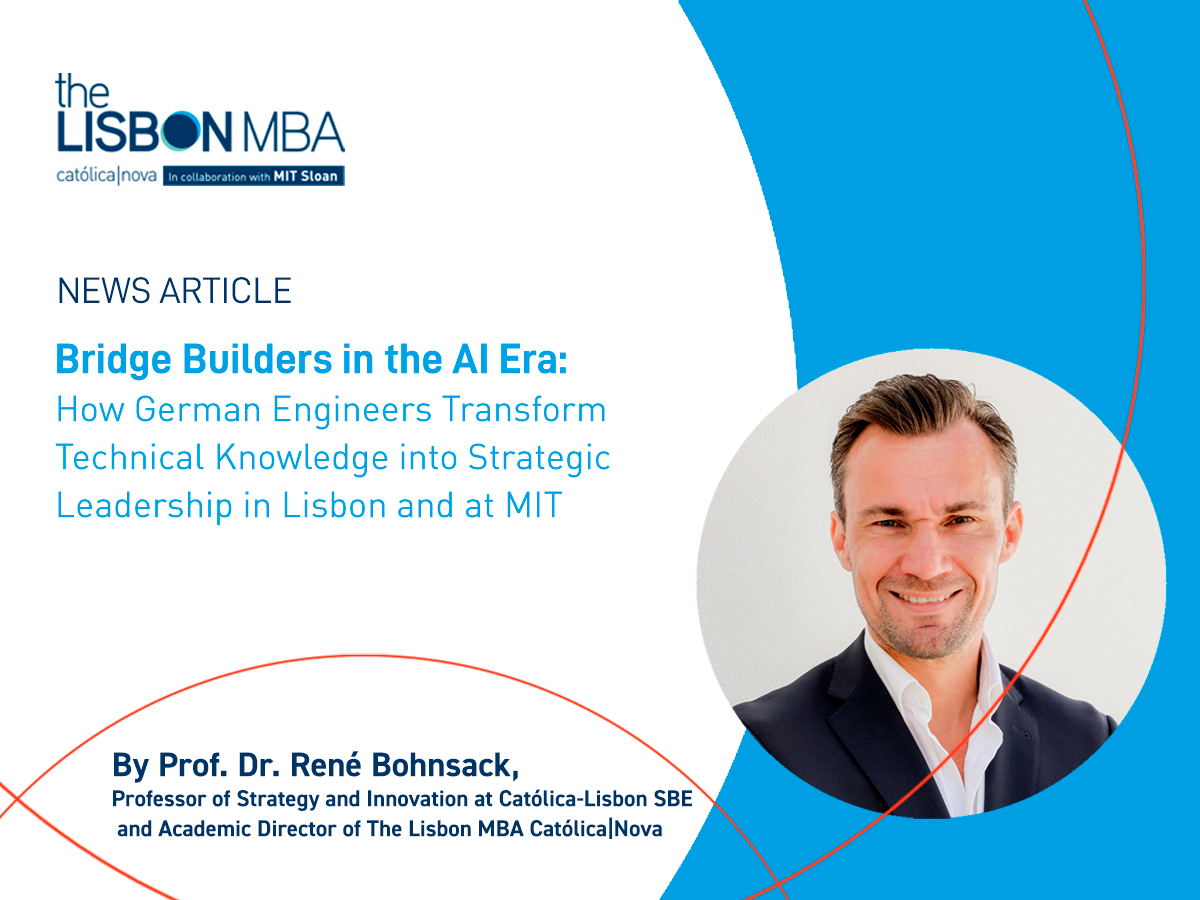
On their way into leadership, engineers have always faced the same question: how does technical expertise become entrepreneurial judgment? Artificial intelligence is changing this question. And it is changing it for the second time right now. The first wave brought assistance systems that respond to inputs. The second wave brings agentic AI — systems that plan, decide, and execute tasks autonomously. With this, the actual leadership task shifts. It is no longer just about translating between technology and management. It is about leading an organization in which humans and autonomous agents work together.
Within companies, a paradox is emerging. AI is becoming more capable and cheaper month after month. Yet most organizations remain stuck in pilot projects that never make it into regular operations. With agentic AI, the gap is even larger. The technology is ready. What is missing is the knowledge of how to reorganize processes, responsibility, and control so that agents create real value. The bottleneck is rarely the technology. It lies with leaders who understand both technology and business logic in equal measure.
This is exactly where engineers have an advantage. They understand how systems work, how data is generated, and where the limits of a technology lie. They can build agents. Designing an agentic organization, however, is a different task. It demands strategy, governance, rethought processes, and leadership. The second half of the equation is not learned in code, but in management. The Lisbon MBA closes exactly this gap.
From Building the Technology to Designing the Organization
For a long time, engineers went to business school to add management to their technical depth. With agentic AI, this relationship reverses in an interesting way. The bottleneck is no longer whether an agent can be built. The bottleneck is how a company reorganizes itself around such agents. That is a management task, and it makes the business school the right place to prepare engineers for the AI transformation. An MBA combines the technical judgment that engineers bring with the strategic language used to make decisions about agentic organizations.
A Program That Builds on Analytical Strength
The Executive MBA of The Lisbon MBA Católica|Nova is a 20-month part-time program. In-person classes take place on one weekend per month and are complemented by evening online seminars. The program is a joint venture of Católica-Lisbon, Nova SBE, and the MIT Sloan School of Management. The curriculum deliberately builds on analytical thinking and leads from there into the logic of business decision-making. We treat the rise of agentic AI not as a side topic, but as the core. Participants learn how AI agents fit into strategy, business models, and operations, and how an organization designs responsibility and control for them. An immersion week at MIT Sloan in Cambridge deepens innovation management and digital business models.
The Frontline of AI Strategy, in the Classroom
Strategy in the age of AI cannot be taught from yesterday’s textbooks. I developed the models I work with in our programs for exactly this task. They lead executives in four steps from experimentation to strategic impact: from the necessary capabilities, through the transformation of the organization and the strategy itself, to the governance of autonomous systems. From this work emerged my book The AI Strategy Playbook: From Zero to 100, which will be published by Routledge in September 2026. It has already accompanied thousands of executives. In the classroom, I work with the same tools. I see it as my task as a professor to build what I teach.
What an MBA from Lisbon Gives Back
The return on such a program shows itself on several levels. Graduates of the Executive program record significant salary increases within a few years. Just as important is the network. Those who complete The Lisbon MBA become part of an alumni community of more than 40,000 members worldwide, with international chapters and lifelong learning offerings. In the AI era, a third return carries even more weight. Leaders who master both technology and strategy make the decisions by which the success of their organization is measured.
A Bridge That Grows More Important in the AI Era
Technical and business knowledge have been merging for years. Agentic AI accelerates this movement. Those who understand both sides build the bridge that others walk across. Engineers who cross it build the agentic organizations of tomorrow rather than merely supplying their tools.
Find out more about The Lisbon MBA, the application requirements, and the career prospects at thelisbonmba.com.
Those who want to go deeper into the strategic side of artificial intelligence will find the complete framework in The AI Strategy Playbook (Routledge)
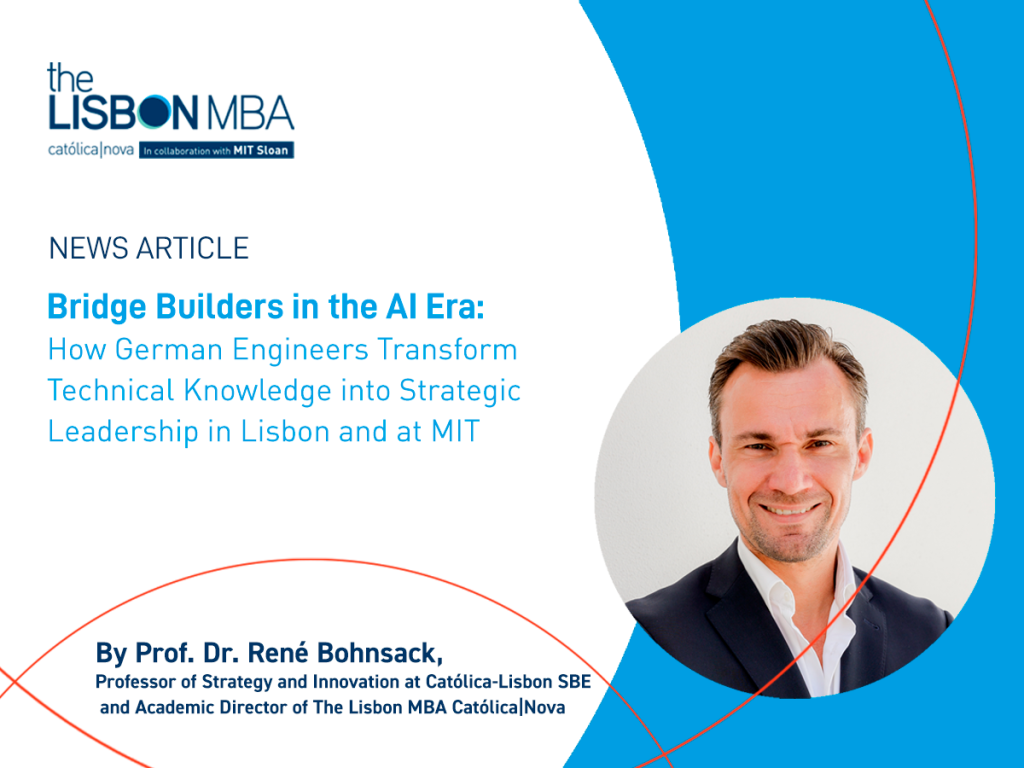
Brückenbauer im KI-Zeitalter: Wie deutsche Ingenieure technisches Wissen in Lissabon und am MIT in strategische Führung verwandeln
Von Prof. Dr. René Bohnsack, Professor für Strategie und Innovation an der Católica-Lisbon SBE und Akademischer Direktor des The Lisbon MBA Católica|Nova
Ingenieure stellen sich auf dem Weg in die Führung seit jeher dieselbe Frage. Wie wird aus technischem Fachwissen unternehmerisches Urteilsvermögen? Künstliche Intelligenz verändert diese Frage. Und sie verändert sie gerade zum zweiten Mal. Die erste Welle brachte Assistenzsysteme, die auf Eingaben antworten. Die zweite Welle bringt agentische KI, also Systeme, die Aufgaben eigenständig planen, entscheiden und ausführen. Damit verschiebt sich die eigentliche Führungsaufgabe. Es geht nicht mehr nur darum, zwischen Technik und Management zu übersetzen. Es geht darum, eine Organisation zu führen, in der Menschen und autonome Agenten zusammenarbeiten.
In den Unternehmen zeigt sich dabei ein Paradox. KI wird Monat für Monat leistungsfähiger und günstiger. Die meisten Organisationen bleiben dennoch in Pilotprojekten stecken, die nie in den Regelbetrieb übergehen. Bei agentischer KI ist die Lücke noch größer. Die Technologie steht bereit. Was fehlt, ist das Wissen, wie man Prozesse, Verantwortung und Kontrolle so neu ordnet, dass Agenten echten Wert schaffen. Der Engpass ist selten die Technologie. Er liegt bei Führungskräften, die Technik und Geschäftslogik gleichermaßen verstehen.
Genau hier sind Ingenieure im Vorteil. Sie verstehen, wie Systeme funktionieren, wie Daten entstehen und wo die Grenzen einer Technologie liegen. Sie können Agenten bauen. Eine agentische Organisation zu gestalten ist jedoch eine andere Aufgabe. Sie verlangt Strategie, Governance, neu gedachte Prozesse und Führung. Diese zweite Hälfte der Gleichung lernt man nicht im Code, sondern im Management. Der Lisbon MBA schließt genau diese Lücke.
Vom Bauen der Technik zum Gestalten der Organisation
Lange gingen Ingenieure an eine Business School, um ihrer technischen Tiefe das Management hinzuzufügen. Mit der agentischen KI kehrt sich dieses Verhältnis auf interessante Weise um. Der Engpass ist nicht mehr die Frage, ob sich ein Agent bauen lässt. Der Engpass ist die Frage, wie ein Unternehmen sich um solche Agenten herum neu organisiert. Das ist eine Management-Aufgabe, und sie macht die Business School zum richtigen Ort, um Ingenieure auf die KI-Transformation vorzubereiten. Ein MBA verbindet die technische Urteilskraft, die Ingenieure mitbringen, mit der strategischen Sprache, in der über agentische Organisationen entschieden wird.
Ein Programm, das auf analytischer Stärke aufbaut
Der Executive MBA des The Lisbon MBA Católica|Nova ist ein 20-monatiges Teilzeitprogramm. Präsenzkurse finden an einem Wochenende pro Monat statt und werden durch abendliche Online-Seminare ergänzt. Das Programm entsteht aus einem Gemeinschaftsprojekt der Católica-Lisbon, der Nova SBE und der MIT Sloan School of Management. Das Curriculum knüpft bewusst an analytisches Denken an und führt von dort in die Logik unternehmerischer Entscheidungen. Den Aufstieg der agentischen KI behandeln wir nicht als Randthema, sondern als Kern. Die Teilnehmer lernen, wie sich KI-Agenten in Strategie, Geschäftsmodelle und Abläufe einfügen und wie eine Organisation Verantwortung und Kontrolle dafür gestaltet. Eine Immersionswoche an der MIT Sloan in Cambridge vertieft Innovationsmanagement und digitale Geschäftsmodelle.
Die Frontlinie der KI-Strategie, im Hörsaal
Strategie im Zeitalter der KI lässt sich nicht aus den Lehrbüchern von gestern unterrichten. Ich habe die Modelle, mit denen ich in unseren Programmen arbeite, für genau diese Aufgabe entwickelt. Sie führen Führungskräfte in vier Schritten vom Experimentieren zur strategischen Wirkung: von den nötigen Fähigkeiten über die Transformation der Organisation und die Strategie selbst bis zur Governance autonomer Systeme. Aus dieser Arbeit ist mein Buch The AI Strategy Playbook: From Zero to 100 entstanden, welches im September 2026 bei Routledge erscheint. Es hat bereits Tausende von Führungskräften begleitet. Im Hörsaal arbeite ich mit denselben Werkzeugen. Ich verstehe es als meine Aufgabe als Professor, das zu bauen, was ich lehre.
Was ein MBA aus Lissabon zurückgibt
Der Ertrag eines solchen Programms zeigt sich auf mehreren Ebenen. Absolventen des Executive-Programms verzeichnen innerhalb weniger Jahre deutliche Gehaltssteigerungen. Ebenso wichtig ist das Netzwerk. Wer den Lisbon MBA abschließt, wird Teil einer Alumni-Gemeinschaft von mehr als 40.000 Mitgliedern weltweit, mit internationalen Chaptern und Angeboten für lebenslanges Lernen. Im KI-Zeitalter wiegt ein dritter Ertrag noch schwerer. Führungskräfte, die Technologie und Strategie zugleich beherrschen, treffen die Entscheidungen, an denen sich der Erfolg ihrer Organisation bemisst.
Eine Brücke, die im KI-Zeitalter wichtiger wird
Technisches und betriebswirtschaftliches Wissen verschmelzen seit Jahren. Agentische KI beschleunigt diese Bewegung. Wer beide Seiten versteht, baut die Brücke, über die andere gehen. Ingenieure, die sie überqueren, bauen die agentischen Organisationen von morgen, statt nur ihre Werkzeuge zu liefern.
Mehr über den The Lisbon MBA Catolica|Nova, die Bewerbungsvoraussetzungen und die beruflichen Perspektiven finden Sie unter thelisbonmba.com.
Wer tiefer in die strategische Seite der künstlichen Intelligenz einsteigen möchte, findet in The AI Strategy Playbook (Routledge) den vollständigen Rahmen